
Risk Partners Life Sciences Roundtable 2025, thank you very much!
Auf einen Blick:
Eine W&I-Versicherung verlagert das wirtschaftliche Risiko aus versicherten Garantieverletzungen und Steuerfreistellungen auf einen spezialisierten Versicherer. Der Käufer erhält einen direkten Anspruch gegen den Versicherer; der Verkäufer kann seine Nachhaftung bei entsprechender SPA-Struktur deutlich reduzieren. Eingesetzt wird W&I in Auktionsprozessen, strategischen Transaktionen, Buy-and-Build-Strukturen, Carve-outs, bilateralen Deals und garantiearmen Verkäuferkonstellationen.
Bei der Garantiehaftung treffen im Unternehmenskauf zwei Interessen aufeinander: Der Verkäufer will einen sauberen Exit ohne jahrelange Nachhaftung, der Käufer einen werthaltigen Rückgriff bei Garantieverletzungen. Die W&I-Versicherung verlagert dieses Haftungsrisiko aus versicherten Garantien und Steuerfreistellungen auf einen spezialisierten Versicherer.
Der Käufer erhält einen direkten Anspruch gegen den Versicherer; der Verkäufer kann seine Nachhaftung bei entsprechender SPA-Struktur deutlich reduzieren. Ob die Police im Schadenfall trägt, hängt von der konkreten Ausgestaltung ab: Garantiekatalog, Disclosure, Due Diligence, Ausschlüsse, Retention, De Minimis und Claims-Mechanik müssen zur Transaktion passen.
W&I ist heute nicht mehr auf PE-Auktionsprozesse beschränkt. Die Police wird auch bei strategischen Käufern, bilateralen Transaktionen, Buy-and-Build-Strategien, Carve-outs und garantiearmen Verkäuferstrukturen eingesetzt, wenn Verkäuferhaftung, Escrow, Garantielaufzeiten, Prozesssicherheit oder interne Risikosteuerung zum Verhandlungspunkt werden. Risk Partners begleitet den Prozess vom ersten Marktfeedback über Underwriting und Policenverhandlung bis zur Anspruchsdurchsetzung im Schadenfall.
A W&I policy is entered into between the buyer and the seller: The insurer assumes the financial risk arising from breaches of warranties and tax representations in the SPA that the seller has made to the buyer. In the event of a claim, the buyer contacts the insurer directly, without first seeking recourse against the seller.

Buy-Side Policy
A buyer’s policy is the standard structure in the European market. The buyer takes out the policy and holds direct claims against the insurer. The seller’s liability is contractually reduced to a minimum and is typically limited tofraud andwillful misconduct. The policy follows the warranty schedule in the SPA and is tailored to the specific transaction structure.
Sell-Side-Prozess und Flip-Struktur
In Auktionsprozessen werden die W&I-Konditionen auf Verkäuferseite vorverhandelt; der ausgewählte Bieter schließt auf dieser Basis die Buy-Side-Police ab (Flip). Das reduziert den Zeitdruck im Signing-Prozess und ermöglicht dem Käufer, auf bereits verhandelte Konditionen aufzusetzen. Die Police ermöglicht dem Verkäufer, den Haftungscap im SPA auf ein Minimum zu reduzieren.
A policy with the seller as the policyholder is also possible. In this case, the scope of coverage follows the terms set forth in the SPA; the coverage extensions typically included in buyer policies (e.g., knowledge scrape, materiality scrape, data room scrape, synthetic inclusions) are not available or are available only to a limited extent.
Synthetic W&I Policies
Bei synthetischen W&I-Policen wird der versicherte Garantiestandard nicht aus dem Verkäufergarantiekatalog im SPA abgeleitet, sondern unmittelbar in der Police definiert. Gedeckt sind damit nicht Schäden aus der Verletzung von Verkäufergarantien, sondern Schäden aus der Verletzung eines in der Police vereinbarten synthetischen Garantiestandards. Die Struktur kommt vor allem in Betracht, wenn auf Verkäuferseite kein belastbarer Garantiegeber vorhanden ist, etwa in Insolvenz- und Distressed-Situationen, oder der Verkäufer keine Garantien abgeben will. Die Underwriting-Anforderungen, die Grenzen bei kenntnisbezogenen Deckungselementen und die Behandlung des Zeitraums zwischen Signing und Closing unterscheiden sich deutlich von der klassischen Buy-Side-Police. Im Detail behandeln wir das auf der Seite Distressed M&A & synthetische W&I.
Scope of Coverage
Eine W&I-Police deckt Vermögensschäden, die dem Käufer aus der Verletzung versicherter Garantien und aus Ansprüchen unter den Steuerfreistellungen entstehen. Ausgangspunkt ist regelmäßig der Garantiekatalog des SPA; der tatsächlich versicherte Umfang ergibt sich jedoch aus der Police. Sie kann den SPA-Garantiekatalog für Deckungszwecke erweitern, modifizieren oder durch Ausschlüsse sowie bekannte oder offengelegte Sachverhalte einschränken. Der praktische Deckungswert steht und fällt daher mit dem Zusammenspiel von SPA, Disclosure, Due Diligence und Police.
Typical areas covered by warranties in W&I underwriting include, in particular:
W&I is not an all-risk policy. Known risks, matters that have been expressly disclosed, and due diligence findings are generally excluded from coverage. The same typically applies to forward-looking warranties, pure purchase price or adjustment mechanisms, and risks that have not been reviewed—or have not been sufficiently reviewed—through due diligence.
Bei bestimmten Themen, etwa Pension Underfunding, Umwelt- und Altlastenrisiken, Cyber-/IT-Risiken, Sanktionen, Anti-Bribery/Corruption, Sekundärsteuer oder identifizierten Einzelrisiken, hängt die Versicherbarkeit stark vom konkreten Risikobild, der Due-Diligence-Tiefe, der Warranty-Formulierung und dem jeweiligen Risikoträger ab. Solche Themen sind nicht automatisch Bestandteil einer Standard-W&I-Deckung, können aber in geeigneten Fällen durch spezifische Einschlüsse, Enhancements oder ergänzende Lösungen wie Tax Liability, Contingent Risk, Specific Indemnity oder Environmental Insurance adressiert werden.
Risk Partners does not analyze exclusions in isolation, but rather in the context of the respective transaction: The decisive factor is what coverage actually remains in the event of a claim after taking into account disclosures, due diligence, scrapes, known or disclosed facts, and policy terms.
The following parameters relate to standard buy-side policies used in European and internationally structured M&A processes. They do not represent rigid standards, but rather current market trends as well as selected structuring and coverage options. The sum insured, retention, premium, terms, underwriting costs, and coverage extensions depend heavily on deal size, sector, jurisdictions, the depth of due diligence, risk profile, and the risk carrier. Therefore, what matters is not which parameters are theoretically achievable, but rather which structure makes economic and coverage-related sense in the specific context of the transaction. This overview is not exhaustive.
| Parameters | Current Market Trends / Selected Negotiable Options |
| Insurance Amount | Typically 10–40% of enterprise value; higher limits available upon request. |
| Retention (Deductible) | Nil retention or tipping-to-nil (0.1–0.5% of EV); fixed retention rates are possible. |
| De Minimis (Exemption Threshold) | EUR 10–30k per individual claim, depending on the transaction. |
| Premium (Rate on Line) | 0.5–1.2% of the insured amount, depending on market conditions and risk; for pure real estate transactions, 0.4–0.7%. |
| Underwriting Costs | The insurer's legal fees are typically EUR 10–25k; they are usually a flat fee. |
| Parameters | Current Market Trends / Selected Negotiable Options |
| Term of General Warranties | 3 years from signing or closing; in some cases, up to 5 years is possible. |
| Term of Fundamental Warranties | Typically 7 years; some providers offer terms of up to 10 years. |
| Term of Tax Warranties / Tax Indemnity | Until the statute of limitations for tax purposes expires, typically 7 years; with some providers, this may be up to 10 years. |
| Parameters | Current Market Trends / Selected Negotiable Options |
| Knowledge Scrape (KS) | The salesperson’s/knowledge person’s knowledge qualification is waived for policy purposes; no proof of knowledge is required in the event of a claim. Available in some cases at no additional charge. |
| Materiality Scrape (MS) | Materiality qualifications in the warranty catalog, such as “significant” or “material,” are disregarded in whole or in part for the purposes of the policy. The SPA remains unchanged. Available in some cases at no additional charge. |
| Data Room (VDR) Scrape | Without VDR Scrape, information contained in the virtual data room may be deemed disclosed or known to the buyer, depending on the policy’s disclosure regime, and may thus limit the scope of coverage. VDR Scrape can limit this blanket presumption of disclosure for the purposes of the policy. Facts that are actually known or specifically identified remain unaffected. Available on a transaction-by-transaction basis for an additional fee; coverage varies depending on the insurer. |
| Due Diligence (DD) Scrape | Without DD Scrape, the due diligence reports available to the buyer may, depending on the policy structure, be deemed a disclosure with respect to the guarantees. DD Scrape can limit this effect for the purposes of the policy. Facts that are actually known or specifically identified remain unaffected. Available on a transaction-by-transaction basis for an additional fee; requirements vary depending on the insurer. |
The quality of a W&I policy cannot be assessed solely on the basis of the premium, retention, or warranty spreadsheet. What matters most is the coverage that actually remains in the event of a claim after all exclusions, definitions, and policy mechanisms have been applied.
Risk Partners unterscheidet deshalb systematisch zwischen der im Warranty Spreadsheet ausgewiesenen Deckung („stated cover“) und der nach Anwendung der Police tatsächlich verbleibenden Deckung („effective cover“). Eine Garantie kann im Warranty Spreadsheet als vollständig gedeckt erscheinen, während ein deal-spezifischer Ausschluss, eine DD-Lücke, eine Kenntniszurechnung, ein Deemed Amendment oder das Offenlegungsregime der Police dieselbe Garantie im Schadenfall faktisch entwertet. In die Auswertung fließen daher nicht nur Prämie und Warranty Spreadsheet ein, sondern die tatsächliche Belastbarkeit der Police nach Anwendung von Ausschlüssen, Offenlegungsregime, Scrapes, Definitionen, Claims-Mechanik und weiteren Policenbedingungen.
In practice, there are five areas that are particularly prone to errors:
Warum der Schadenfall der eigentliche Test ist
Die Marktdaten zeigen ein klares Muster: Nach den aktuellen Claims-Studien führender Marktteilnehmer erhält in Europa etwa jede achte W&I-Police eine Schadenmeldung. Die häufigsten Meldegründe sind Steuergarantien und Financial-Statements-Garantien mit einem wesentlichen Unterschied: Steuerbezogene Meldungen entstehen oft aus routinemäßigen Betriebsprüfungen und führen selten zu Zahlungen, während Verletzungen der Financial-Statements-Garantien den größten Teil der tatsächlich regulierten Schäden ausmachen.
Für die Policengestaltung folgt daraus: Die Qualität einer W&I-Deckung entscheidet sich an den Garantiebereichen, in denen Schäden realistisch entstehen und reguliert werden. Ein Ausschluss oder eine Underwriting-Bedingung bei den Bilanzgarantien wiegt im Ernstfall schwerer als eine großzügige Position in einem Bereich ohne Schadenrelevanz.
Risk Partners begleitet Mandanten im Schadenfall von der fristgerechten Notifizierung über die Aufbereitung der Anspruchsgrundlage bis zur Verhandlung mit dem Versicherer, in enger Abstimmung mit den rechtlichen Beratern des Mandanten.
Ideally, the W&I process runs in parallel with the transaction. The earlier Risk Partners is brought on board, the more flexibility there is for structuring decisions, exclusion negotiations, and coordination with the deal team. For transaction lawyers and corporate finance advisors, it is crucial that the insurance solution does not slow down the transaction. Risk Partners therefore closely coordinates market outreach, NBI deadlines, underwriting requirements, and policy negotiations with the SPA timeline, due diligence process, bidding process, and signing mechanics.
The following overview shows the typical process for a buy-side policy. The minimum time required between initial contact and policy placement is approximately 1–2 weeks.
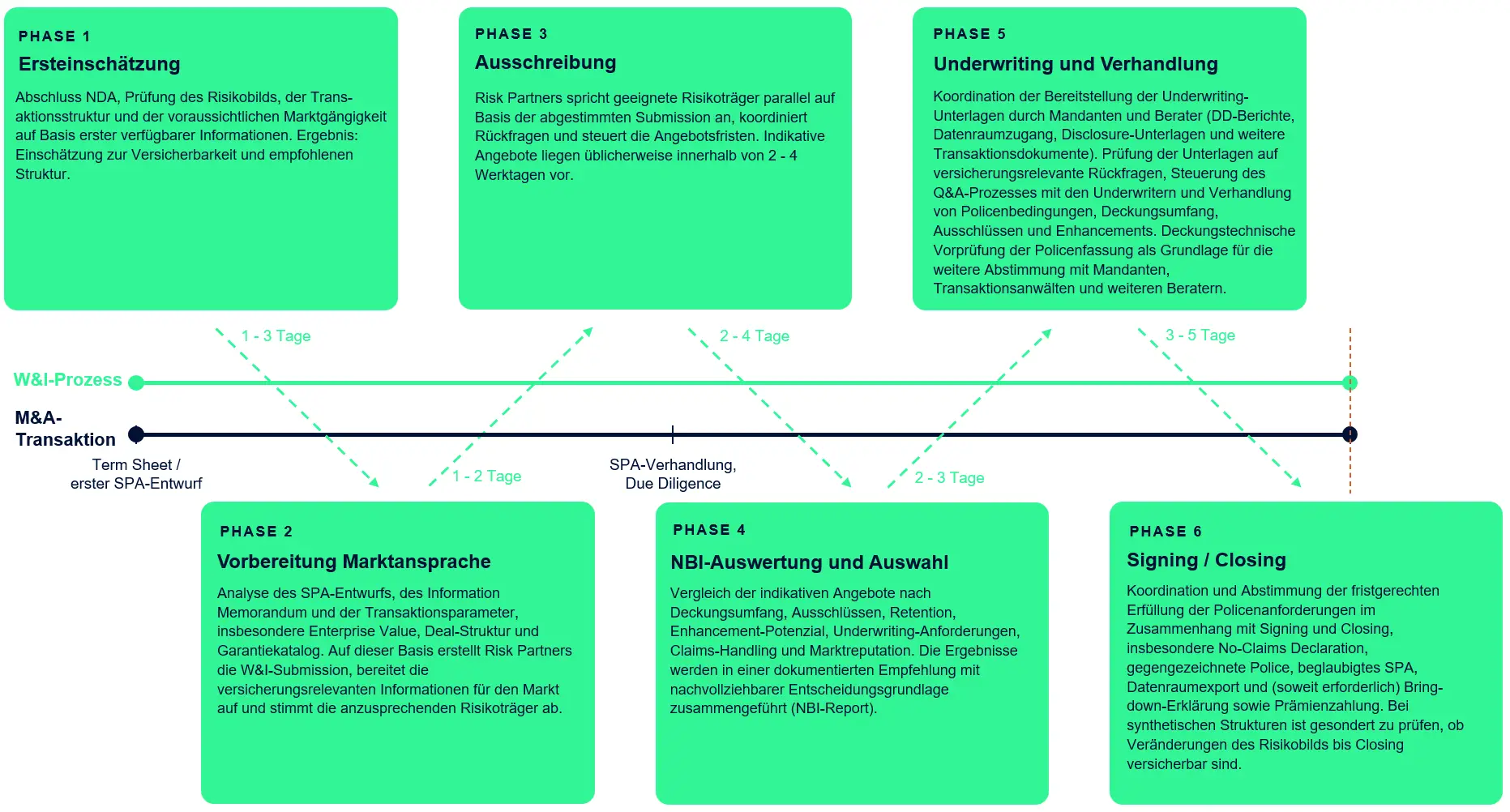
The amount of information required varies depending on the stage of the process. Significantly fewer documents are required for the initial assessment and request for proposals than for underwriting. A complete due diligence (DD) package is not required until after the insurer has been selected.
In specific risk situations, it may be advisable to take relevant due diligence findings into account even before selecting a risk carrier. This is particularly true when it is necessary to assess at an early stage whether an issue can be addressed within the W&I policy or whether an alternative structure—such as contingent risk, tax liability, or specific indemnity insurance—is more appropriate.
Initial Assessment and Request for Proposals (NBI Phase)
Underwriting Phase (after selection of the risk-bearing entity)
The underwriting process is conducted primarily in writing. For complex issues, phone calls remain useful or necessary. After reviewing the documentation, the underwriters ask specific questions regarding due diligence findings, outstanding warranty positions, disclosure gaps, or transaction-specific issues. Risk Partners coordinates the Q&A process and manages communication between underwriters, transaction counsel, and tax advisors.
In the case of synthetic W&I structures, a particularly thorough buyer-side due diligence is required with respect to the areas to be insured, as seller warranties and seller disclosures are available only to a limited extent, if at all.
In competitive bidding processes, W&I insurance is often part of the process design. For sellers, the primary goal is typically to achieve an exit with as little liability as possible; for buyers, the goal is to obtain robust protection against unknown risks despite reduced seller liability. Buyers who can present robust W&I terms early on are therefore able to submit a more seller-friendly offer, such as one with a reduced escrow, limited seller liability, and clear coverage under the policy. Low or zero deductibles, in particular, improve the economic quality of the buyer’s offer because they reduce the buyer’s uninsured residual risk. The flip structure makes it possible to prepare W&I terms on the seller’s side during the sell-side process and to finalize them quickly after the preferred bidder is selected, up until signing.
In the case of repeated acquisitions as part of a buy-and-build strategy, W&I can create a standardized protection structure that can be efficiently reused and adapted for individual add-on transactions. Platform companies and private equity investors benefit from repeatable underwriting processes, clearer requirements for due diligence and warranty schedules, and more predictable protection against unknown post-closing risks. Particularly for smaller add-ons, W&I can also help structure seller liability, escrow, and warranty terms early on, without having to redefine liability terms for each transaction.
For strategic acquirers, W&I is not only a tool for securing the transaction but also a means of internal risk management. The policy can help to more accurately assess the financial impact of unknown warranty breaches after closing and to allocate them more clearly within the organization, particularly when group approvals, board decisions, or post-closing integration require a transparent allocation of risk. W&I is also relevant when the seller does not accept extensive extended liability or when the buyer does not wish to have primary recourse to the seller after closing but still requires viable protection against unknown risks.
Synthetic W&I is particularly relevant when a traditional seller warranty regime is not available or is only available to a limited extent, such as in insolvency sales, distressed transactions, carve-outs, or when sellers are unwilling to provide comprehensive warranties. In these cases, the buyer does not receive protection from seller warranties but can obtain a defined synthetic warranty standard against unknown risks through the policy.
A prerequisite is robust due diligence on the buyer’s part. Only those areas covered by the warranty that have been sufficiently reviewed are eligible for coverage; risks that have not been reviewed or identified are typically excluded. In the case of insolvency sales or other transactions with limited warranties, a synthetic W&I policy can broaden the pool of potential buyers and reduce price discounts, but this requires early coordination of due diligence, the data room, the transaction timeline, and underwriting requirements.
Mehr erfahren unter: Distressed M&A & synthetische W&I.
In bilateral transactions, W&I can help break deadlocks in negotiations regarding escrow, seller liability, or warranty periods. The buyer receives direct coverage through the policy, while the seller can reduce—or, in appropriate cases, avoid—escrow arrangements, purchase price withholdings, or extended liability. This is contingent on the relevant warranty areas being insurable and supported by sufficient due diligence. In this way, tied-up capital can be reduced without the buyer having to completely forgo protection against unknown risks.
From the seller’s perspective, W&I can help significantly reduce ongoing financial liability after closing, provided that the SPA structure and the policy are properly aligned. This is particularly relevant in the case of exits by founders, family shareholders, management teams, or financial investors, when the goal is to avoid or reduce escrow, holdbacks, purchase price withholdings, or long warranty periods. The policy does not replace a well-structured SPA, but it can help resolve differing liability expectations between the buyer and seller. If sellers are unwilling to provide any warranties—or only very limited ones—a synthetic W&I structure may be worth considering as a supplement.

How does Risk Partners provide support?
We are available on short notice to provide an initial assessment of the insurability, marketability, or structuring of a W&I solution (even based on an early draft of the SPA or term sheet).
Rufen Sie uns an unter der Nummer +49 160 92598958 oder schreiben Sie uns: dealinsurance@riskpartners.de.
This article is intended for general informational purposes only and does not constitute specific legal, tax, or insurance advice. Whether and to what extent insurance coverage is available depends on the specific facts of the case, a legal review, the insurers’ underwriting requirements, and the final terms of the policy.