
Risk Partners Life Sciences Roundtable 2025, thank you very much! 

OLG Schleswig: Limitation of the liability claim
in the case of a direct claim in the D&O insurance.

There is a new, exciting ruling from the world of D&O insurance. We recently reported on the decision of the Higher Regional Court of Cologne in the context of direct action. Now the Higher Regional Court of Schleswig has also made a groundbreaking decision.

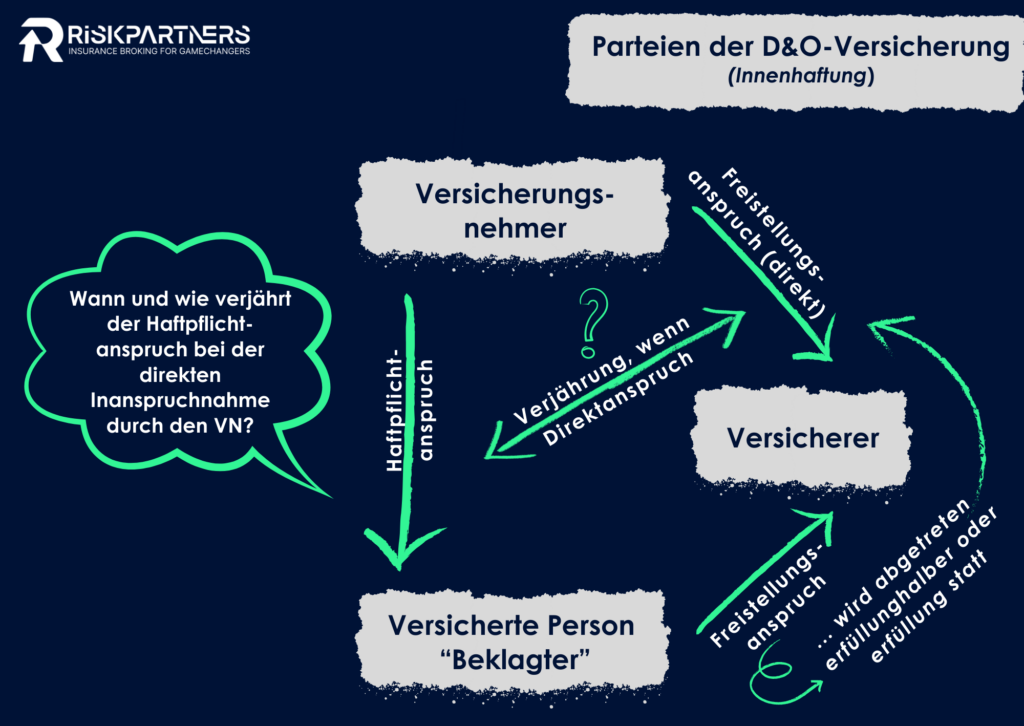
What was it about? The focus was on the question of the statute of limitations. However, it must be borne in mind that the question of the limitation period in D&O claims is not trivial. On the one hand, there is the original claim for damages (statutory directors' and officers' liability separate from the D&O insurance) as well as a claim under cover law that arises between the parties - insurer, insured persons and insured companies - due to the conclusion of the D&O insurance. Now both the claim for damages and the contractual claims under the D&O insurance can become time-barred. If the limitation period for the claim under cover law is now suspended by filing a direct claim or a direct action with the insurer, what does this mean for the necessary liability claim? Can an insurer release itself from liability in this case if the claim is already time-barred? The decision of the Higher Regional Court of Schleswig has now clarified this question.

Background: A fire at a bakery caused significant damage, only a portion of which was covered by the fire insurance policy—rightfully so, based on the terms of the contract. (Note: We therefore recommend regularly documenting and reviewing both the insured amounts and the specific terms of the insurance coverage.) The bakery operator claimed the remaining damages by holding the managing director liable for breach of duty. As a result, the managing director assigned his right to indemnification under the D&O insurance to the company (see the attached diagram). D&O insurance typically covers a company’s executives. In the event of a claim, claims must first be asserted against the insured person before they can be enforced against the insurer. This often results in complex and time-consuming liability and coverage disputes. In practice, the dispute is increasingly being litigated in a direct action, through the assignment of the insured person’s right to indemnification to the policyholder. This allows the policyholder to assert its claims directly against the insurer. Regarding the decision: In its ruling of February 26, 2024 (Case No. 16 U 93/23), the Higher Regional Court of Schleswig held that this assignment of the right to indemnification constitutes a “ceasefire agreement” (pactum de non petendo) was implicitly concluded. This agreement prevents liability proceedings against the managing director as long as the claim against the insurer exists and suspends the statute of limitations for statutory liability claims. The suspension under insurance coverage law resulting from the filing of a direct action or a direct claim with the insurer thus also suspends the statutory statute of limitations.

The ruling by the Higher Regional Court of Schleswig fundamentally strengthens the position of companies that wish to take direct action against their D&O insurers. It deprives insurers of a further opportunity to reject claims without an indemnification. This makes it more attractive to take direct action against the D&O insurer rather than against the responsible managers. In addition to the transfer of control by the manager concerned, especially in the case of an assignment on account of performance in accordance with section 364(2) of the German Civil Code (BGB), there are other aspects to consider. These include, for example, the effects on public limited companies under the strict AG regime and, in principle, the disadvantages associated with the "direct action", such as contractual insurance obligations in the event of a claim. For this reason, Risk Partners will continue to closely monitor developments relating to direct action on behalf of our clients. We at Risk Partners will stay on the ball for you.

Also read our other blog posts

Cyber Security

"Digital Operational Resilience Act" (DORA regulation) from the perspective of venture capital and private equity funds

DORA regulation applies from January 2025. Significance for our private equity and venture capital clients The somewhat unwieldy name "Digital Operational Resilience Act" (DORA for short) has a very serious background and is fundamentally to be welcomed. After all, when we evaluate our claims in the context of cybercrime, PE and VC funds and their KVGs are those with the highest frequency of claims. It can be safely assumed that they are a "worthwhile target group" for cyber criminals based abroad.

Read more "
Life Sciences

Cyber Risks: Case Study Evotec

Last year, more than 10 percent of German companies were affected by an IT security incident, with the proportion rising due to cyber attacks. Biotechnology is not excluded either. It is possible to learn from the Evotec case. It is about successful cyber attacks or other incidents that are important for security, such as acts of sabotage or hardware theft. According to a representative Ipsos survey conducted on behalf of the TÜV association among 501 companies with more than ten employees. According to the TÜV

Read more "
Management

How managers protect themselves from personal liability in the event of cyber incidents - #29Minutes by Control Risk & Risk Partners

How directors and officers protect themselves from personal liability in the event of cyber incidents - #29Minutes by Control Risk & Risk Partners Looking at our claims experience in the area of directors' and officers' liability in recent years, internal claims alleging inadequate cyber risk management and emergency management in the event of a cyber attack are unfortunately on the rise. In addition to special risk transfer solutions (cyber and CDI insurance), there are also very practical tips on how to react correctly if the worst comes to the worst. Following an exchange at a risk management conference in Q1 of this year

Read more "
Being Public

Risk Partners supports successful uplisting of Formycon AG to the Prime Standard

Congratulations to Formycon AG on its successful uplisting to the Prime Standard of Deutsche Börse on November 12, 2024! Welcome to the Prime Standard league: A new champion of life sciences and biosimilars has successfully made the step from the Scale segment. We proudly congratulate Enno Spillner, Dr. Caroline Redeker, Daniel Marquard and the entire Formycon AG team on this great success and another important milestone on their way to becoming a global champion in the field of biosimilars! Formycon AG has focused on

Read more "
IPO

New: Risk Partners POSI Insurance for MiCAR White Paper

MiCAR Compliance? We Cover the Risk! The MiCAR Regulation (EU 2023/1114) exposes crypto-asset service providers and whitepaper authors to significant liability risks. Incomplete, inaccurate, or misleading information in white papers can have significant consequences for Crypto-Asset Service Providers (CASP) and authors—ranging from regulatory sanctions to civil claims. Our solution: Risk Partners Tech POSI MiCAR Whitepaper Protect 2025 The creation and publication of white papers under MiCAR entails complex liability pitfalls: In addition to civil claims (e.g., under the German Civil Code) and criminal risks, there is a threat of

Read more "
Being Public

Earnings Call: one 0 too many - the Lyft CEO mistake

"Look, it was a bad mistake, and that's on me," CEO of LYFT Inc. The incident and possible insurance coverage. You may have also heard about the recent incident with LYFT. In the quarterly earnings report, LYFT originally stated that profit margins were up 500 basis points before correcting this to 50 basis points during the conference call. This clerical error caused the stock price to rise more than 60% in after-hours trading. This situation is exactly what investor relations teams that

Read more "