
Risk Partners Life Sciences Roundtable 2025, thank you very much! 

HSG St. Gallen: Drug costs USD 6.16 billion on average.

Are the days of new drugs for less than USD 1 billion over?

Figures in the industry spoke of USD 700-1,000 million as the cost of developing a new drug. A study by the University of St. Gallen covering the period 2001-2020 found that the cost of developing new drugs has risen dramatically. It was estimated that the cost of developing a new drug is now around 6.16 billion US dollars, a significant increase on previous estimates. The study looked at various factors contributing to this cost increase, including increasing regulation and the need to conduct larger clinical trials.

The authors of the study argue that these high costs for the development of new drugs lead to a growing gap between large pharmaceutical companies and smaller biotech companies. While large pharmaceutical companies are still able to bear the high costs of developing new drugs, smaller companies are often unable to keep up and must either focus on developing less complex drugs or merge with a large pharmaceutical company. In addition, the US stock market in particular will continue to gain in importance as a source of financing. 

Hostility to innovation at the expense of patients


The study suggests that there is a need to find new ways to reduce the cost of developing new drugs and improve access to these drugs. One way is to strengthen collaboration between companies and academic research institutions and reduce the cost of clinical trials. Another way is to simplify regulation to reduce the cost and time it takes to get new drugs approved.

Overall, the study is an important finding for the pharmaceutical and biotechnology industry and shows that there is a need to find new ways to reduce the cost of developing new drugs in order to improve access to these vital medicines.

Risks increase as of day 1.

For us as risk experts, we can deduce from this that our clients' loss distributions are already shifting upwards from the outset and are "playing in a new league" with the Phase 2 study. In this context, in addition to the protection of company assets (e.g. molecules), adjustments to manager protection will also be required, which, in addition to clever concepts (e.g. with a view to an IPO), will above all also include higher sums insured, e.g. in D&O insurance. In addition, particularly with regard to the biotech landscape active in the DACH region, a campaign driven by politicians must be launched to reduce costs. 

Also read our other blog posts

Management
Björn Stressenreuter

Capital requirements for (fully regulated) AIFMs

What are the capital requirements for an asset management company? Together with experts Johannes Kiefer (Director of Risk & Compliance at Landsiedel & Partner) and Henry Franz (Managing Director of Layline.tax), we were able to compile our combined expertise on capital requirements, ranging from registered asset management companies to fully licensed ones. In this issue of VC Magazine, we share how E&O insurance, among other things, can provide added value. In addition to our article available below, please also check out the link to the online edition of Venture Capital Magazine. Enjoy!


Read more "
IPO
Björn Stressenreuter

Risk Partners is advising Terranor Group AG on its NASDAQ (Sweden) IPO

From Road Builder to IPO Candidate: How Terranor Group AB Conquered Nasdaq First North. It was a day that marked a new chapter not only for Terranor Group AB but for the entire Nordic infrastructure sector: On June 19, 2025, the Swedish company celebrated its successful initial public offering on the Nasdaq First North Premier Growth Market in Stockholm. Risk Partners as IPO Advisor For while Terranor Group shares began trading under the ticker symbol TERNOR on June 30, 2025,

Read more "
IPO
Björn Stressenreuter

New: Risk Partners POSI Insurance for MiCAR White Paper

MiCAR Compliance? We Cover the Risk! The MiCAR Regulation (EU 2023/1114) exposes crypto-asset service providers and whitepaper authors to significant liability risks. Incomplete, inaccurate, or misleading information in white papers can have significant consequences for Crypto-Asset Service Providers (CASP) and authors—ranging from regulatory sanctions to civil claims. Our solution: Risk Partners Tech POSI MiCAR Whitepaper Protect 2025 The creation and publication of white papers under MiCAR entails complex liability pitfalls: In addition to civil claims (e.g., under the German Civil Code) and criminal risks, there is a threat of

Read more "
Being Public
Björn Stressenreuter

Prospectus liability insurance (POSI): Risk Partners publishes for you

Risk Partners on Going Public and the capital market blog on prospectus liability insurance In recent months, we have been able to share our expertise on prospectus liability insurance with a wide audience on two renowned platforms. Here is an overview: Kapitalmarkt.blog In the article "POSI insurance - The protective vest on the capital market", we explain why prospectus liability insurance is an indispensable tool for companies becoming active on the capital market. The article shows in a practical way how such insurance not only minimizes liability risks, but also strengthens investor confidence. GoingPublic Magazine In

Read more "
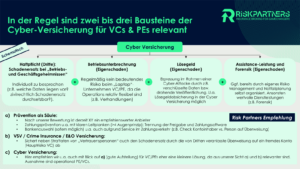
4 pillars of cyber insurance for venture capital and private equity
Cyber Security
Björn Stressenreuter

Cyber insurance Venture capital and private equity

Why cyber insurance does not transfer the core risk of VC & PE funds and why we have invested in Risk Partners cyber master agreements. Why cyber risks are relevant for venture capital and private equity funds With the increasing growth of the cyber crime industry (see Federal Office for the Protection of the Constitution), venture capital (VC) and private equity (PE) funds and their fund managers are also increasingly exposed to cyber risks. For years, this has been reflected in the claims we have been able to support, in which fund managers have ranked first year after year among the industries we advise.

Read more "
Cyber Security
Björn Stressenreuter

"Digital Operational Resilience Act" (DORA regulation) from the perspective of venture capital and private equity funds

DORA regulation applies from January 2025. Significance for our private equity and venture capital clients The somewhat unwieldy name "Digital Operational Resilience Act" (DORA for short) has a very serious background and is fundamentally to be welcomed. After all, when we evaluate our claims in the context of cybercrime, PE and VC funds and their KVGs are those with the highest frequency of claims. It can be safely assumed that they are a "worthwhile target group" for cyber criminals based abroad.

Read more "
Your question has not been answered?
We will be happy to advise you in a free initial consultation.